
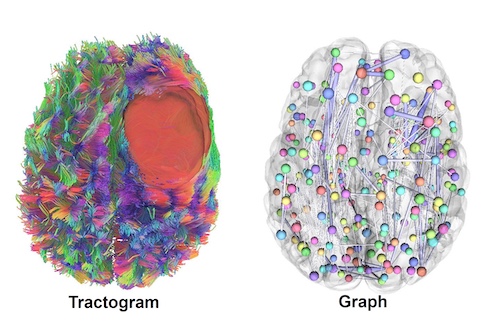
A study led by Karl Landsteiner University shows that the disease affects whole-brain communication networks, and that this may help predict survival.
Krems, Austria, 21 April 2026 – Glioblastoma, the most aggressive malignant brain tumor in adults, is not an isolated lesion, but a disease that destabilizes the brain’s communication network. A new study shows that survival is closely linked to how strongly the tumor affects large-scale white matter connections, the pathways that allow distant brain regions to exchange information. Using preoperative MRI data and computer-based analysis, the international research team found that network-related measures predicted one-year survival more accurately than basic clinical factors alone. The work, led by Karl Landsteiner University (KL Krems), reflects a broader shift in brain tumor research: away from looking only at the tumor itself and toward assessing how it disturbs the surrounding brain. This could help refine prognosis and support more individualized treatment decisions.
Glioblastoma remains difficult to treat despite surgery, radiotherapy, and chemotherapy. One reason is that the tumor does not simply grow as a compact mass. It also infiltrates white matter, the “wiring” of the brain, and can thereby disrupt communication between regions that are essential for movement, memory and cognition. That makes it important to look beyond size and location alone, especially for predicting overall survival. Researchers at the Institute of Medical Radiology at the University Clinic of St. Pölten, a teaching and research site of KL Krems, therefore investigated how glioblastoma alters the brain’s structural connectome — the network of white matter links connecting different brain regions — as a whole.”
“Our results suggest that glioblastoma should be viewed as a disease of distributed network failure,” says Prof. Andreas Stadlbauer, first author of the study. “Prognosis depends not only on the tumor itself, but also on whether crucial brain connections remain intact.”
Connection Lost?
To study this, Prof. Stadlbauer together with colleagues from Germany and the USA analyzed preoperative diffusion tensor imaging, (DTI – a special MRI method that visualizes white matter pathways), from 871 patients in two public databases. They then used so-called graph-theoretical analysis (a mathematical method for describing the structure of a network) to calculate whether certain brain regions had lost connections or become less efficiently linked.
These measures were then used in machine-learning models to predict whether patients of a separate sub-group would survive longer than one year. Because the actual overall survival was known, the prediction could be compared with the real outcome. In this separate test group, the best predictions reached an accuracy of up to 87.4 percent. This level of accuracy underlines the promise of network-based analysis to improve prognosis in glioblastoma.
Networking
Particularly informative were measures such as “strength” (how strongly a brain region is connected overall), “degree” (the number of direct links between brain regions), and the “clustering coefficient” (how tightly neighboring regions form local groups). Many of the most relevant nodes lay in the temporal lobe, especially areas linked to memory and higher cognition, while the thalamus and the motor region of the frontal lobe also stood out. Put simply, the findings suggest that glioblastoma becomes especially dangerous when it affects highly connected hubs and local subnetworks that help the brain compensate for damage.
The study fits a wider trend in neurology: In stroke, epilepsy, and neurodegenerative disorders, researchers increasingly use “connectomic” biomarkers, meaning markers based on the brain’s network organization rather than on isolated lesions. These findings now bring that perspective to glioblastoma. They suggest that network-based markers may help classify risk more precisely at diagnosis, identify patients for intensified or experimental therapies, and inform connectome-guided neurosurgery aimed at preserving critical pathways. At the same time, the authors stress that the approach still requires external validation before it can be used routinely in clinical care. The study also emphasizes KL Krems’ research focus at the interface of neuroscience and molecular oncology.
Original publication: Machine-Learning-Based Survival Prediction in Glioblastoma Using Graph-Theoretical Analysis of Structural Network Alterations, A: Stadlbauer; S: Oberndorfer; G: Heinz; F: Marhold; T M: Kinfe; M: Dorostkar; O: Schnell; U: Meyer-Bäse; A: Meyer-Bäse, Cancers 2026, doi: 10.3390/cancers18071161.
https://kris.kl.ac.at/en/publications/machine-learning-based-survival-prediction-in-glioblastoma-using-/
More on KL Krems research: https://www.kl.ac.at/en/research/research-blog
Karl Landsteiner University (04/2026)
The Karl Landsteiner University (KL Krems) is an internationally recognized educational and research institution located on the Campus Krems. KL Krems offers modern, demand-oriented education and continuing education in medicine and psychology as well as a PhD programme in Mental Health and Neuroscience. The flexible educational programme is tailored to the needs of students, the requirements of the labour market and the challenges of science. The three university hospitals in Krems, St. Pölten and Tulln and the MedAustron Ion Therapy and Research Centre in Wiener Neustadt guarantee clinical teaching and research of the highest quality. In its research, KL Krems focuses on interdisciplinary fields with high relevance to health policy – including mental health and neuroscience, molecular oncology as well as the topic of water quality and the associated health aspects. KL Krems was founded in 2013 and accredited by the Austrian Agency for Quality Assurance and Accreditation (AQ Austria).
Scientific Contact
Prof. Dr. Andreas Stadlbauer
Institute of Medical Radiology
University Hospital St. Pölten
Karl Landsteiner University
Dr.-Karl-Dorrek-Straße 30
3500 Krems / Austria
T +43 2742 9004-14198
E andreas.stadlbauer@stpoelten.lknoe.at
Karl Landsteiner University
Mag. Selma Vrazalica, BA
Communication, PR & Marketing
Dr.-Karl-Dorrek-Straße 30
3500 Krems / Austria
T +43 2732 72090 237
M +43 664 883 99 603
Copy Editing & Distribution
PR&D – Public Relations for Research & Education
Dr. Barbara Bauder-Jelitto
Kollersteig 68
3400 Klosterneuburg / Austria
M +43 664 1576 350
L https://www.linkedin.com/company/prd-public-relations-für-forschung-bildung